
Your cart
There are no more items in your cart
Search in blog

Regulation (EU) No 1169/2011 lists 14 categories of substances or products causing allergies or intolerances (food allergens):
For food products, the indication on the label of these substances follows the specifications of the regulation. The management of food allergens constitutes an important part of the HACCP self-control system and must consider all phases of the production process, from the selection of raw materials up to the finished product.
In particular, great attention must be paid to the production lines used both for foods that contain allergens and for products that are free of them, and it is also fundamental that surfaces and equipment in contact with food are easily accessible, cleanable, and sanitizable, thus avoiding areas difficult to reach in which unwanted residues can accumulate.

The search for allergens can be carried out using different methods selected depending on the matrix to be analyzed, the allergen to be searched for, and the purpose of the analysis. Food or surfaces, machinery, air, etc. can be analyzed. Screening analyses can be done, preferred in the intermediate phases of production, or analyses for the release and labeling of the product can be performed.
Rapid analyses in the agro-food and environmental fields are of considerable interest in the search for food allergens in the production setting or in preparation in collective catering. Tests for the search for food allergens are applied to food and aqueous matrices, production surfaces, and air samples.
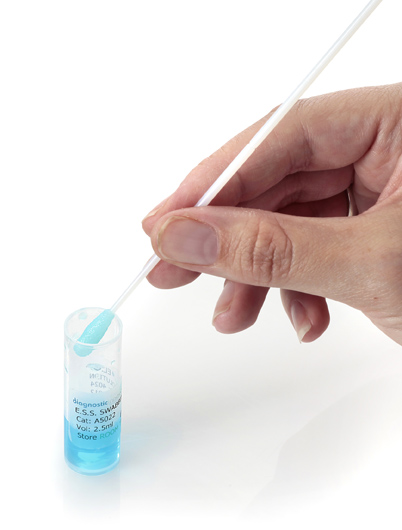
There are many variants of tests to detect food allergens, which differ, for example, in sensitivity and target.
Over time, Kairosafe has selected various types of tests for its catalog to perform analyses using three methods:
These are tests that differ in technology and complexity of analysis, but also in the speed of obtaining results, necessary instrumentation for execution and operator training, and the nature of the results themselves.
Qualitative rapid tests have few and simple sample preparation steps and a visual reading. They are used in the field or in the intermediate stages of food production or preparation, to have a fast result useful for immediate intervention. These tests detect the presence or absence of a target beyond a specific sensitivity threshold.
Quantitative tests are immunoenzymatic or qPCR tests used to quantify a molecule or a protein target within a matrix. The result is a precise measurement obtained through various sample preparation steps and a reading with specific instrumentation.
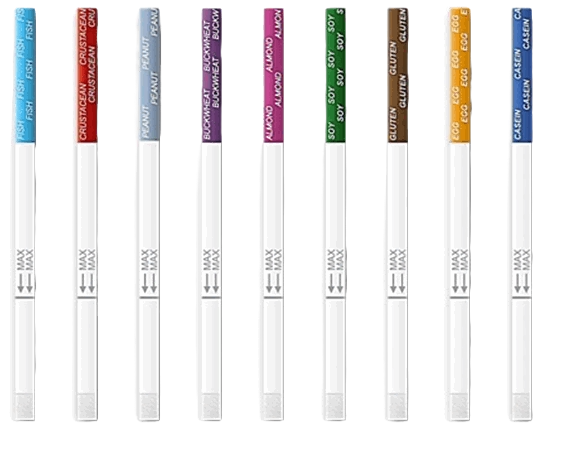
Also known as Lateral Flow Assays - LFA, qualitative rapid tests.
These are rapid tests with visual reading that offer quick results for the qualitative detection of allergens; widely used in screening or in situ tests, especially in intermediate stages of production or in the collective catering sector.
Lateral flow immunochromatographic tests are made on porous material supports and are based on the migration of particles that determine the formation of colored bands: along the path on the support, the target protein interacts with antibodies associated with colored particles that lead to the formation of colored bands representing positivity to the test.
Result: qualitative or semi-quantitative; more specifically, it provides a binary outcome relative to a threshold (positive/negative).
Analysis time: approximately 20 total minutes per sample.
Instrumentation: reading is visual and performed with the naked eye. Small instrumentation may be necessary for sample preparation.
Advantages: applicable to matrices and surfaces, speed of execution, elimination of waiting times for the release of a production line, absence of investment costs in laboratory machinery, and high effectiveness for cleaning verifications.
Disadvantages: impossibility of quantifying the data and possible interferences or false negatives in the presence of very complex, concentrated, or processed food matrices.
Uses: monitoring of surfaces pre- and post-sanitization; raw material acceptance (rapid control upon goods receipt to immediately block non-compliant batches).
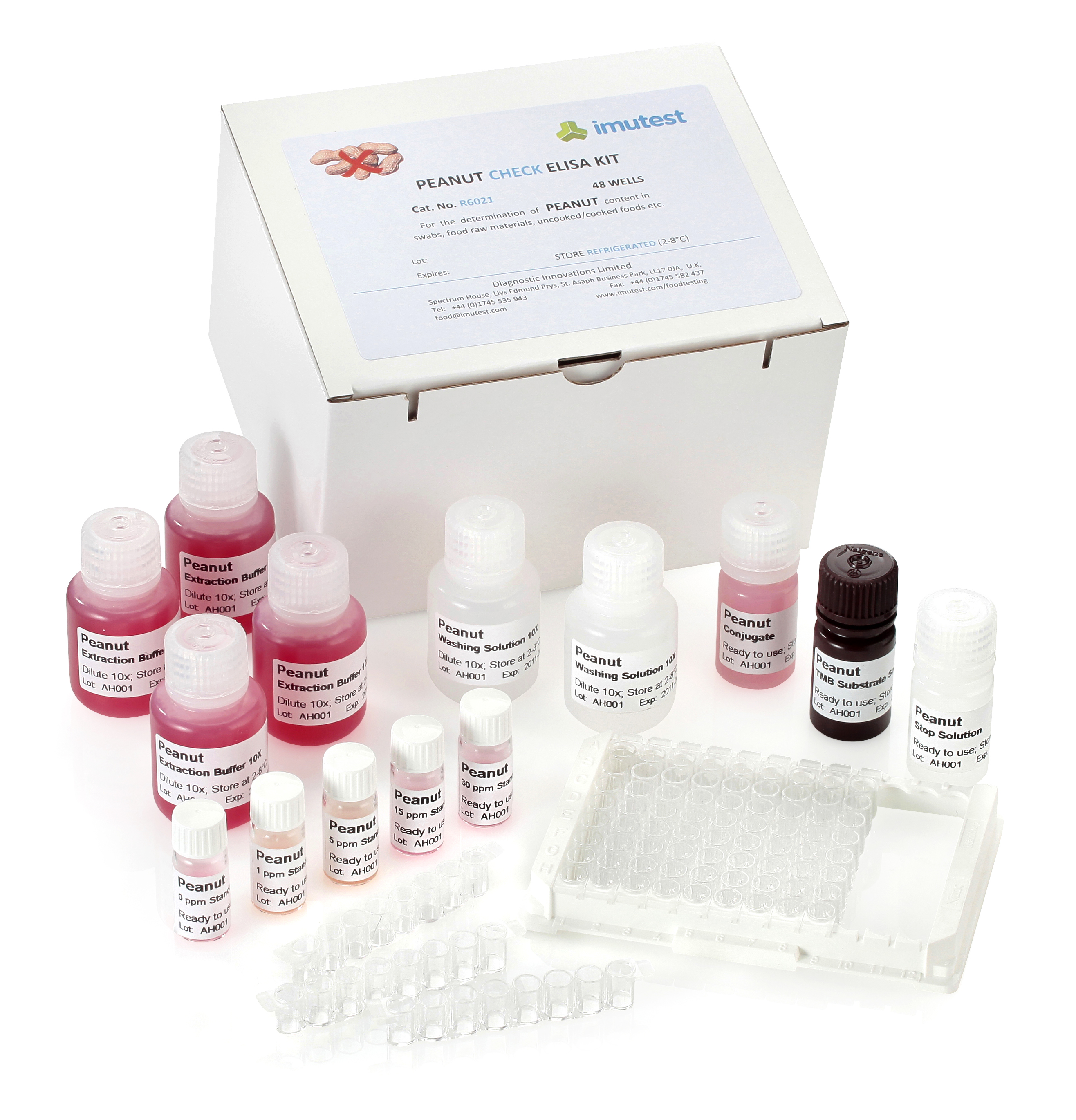
ELISA tests are based on the interaction between a specific antibody for the protein of interest and the protein itself, detecting the reaction with an enzyme that produces a signal detectable with an optical reader.
The test is quantitative as the reading is automated and the result indicates a contamination in numerical terms. The addition of a suitable substrate induces a chromogenic reaction: the appearance and intensity of the color, measured via spectrophotometer and compared with a calibration curve, are directly proportional to the concentration of the analyzed target.
Result: quantitative; expressed as exact concentration (ppm, mg/kg, or µg/kg).
Analysis time: from 2 to 4 total hours (including incubation and washing cycles). Instrumentation: microplate spectrophotometer, precision pipettes, and automatic washer.
Advantages: applicable to matrices and surfaces, high analytical accuracy, reproducibility of results, capacity to analyze up to 96 samples in parallel, and official validation for verifying legal limits.
Disadvantages: longer execution times, need for a dedicated laboratory, and costs related to analytical equipment.
Uses: label verification to check if a declared value is correct before writing it on the package; trace management ("May contain...") to precisely calculate the risk of contamination and decide whether to include warnings for allergy sufferers on the label; analysis of foods that have undergone cooking or intense industrial processing, where proteins may be altered.
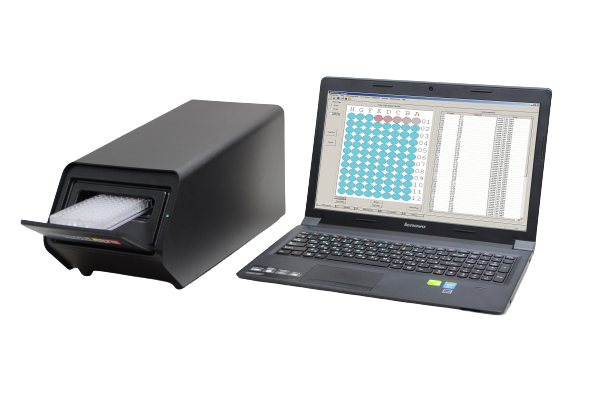
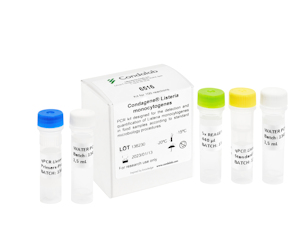
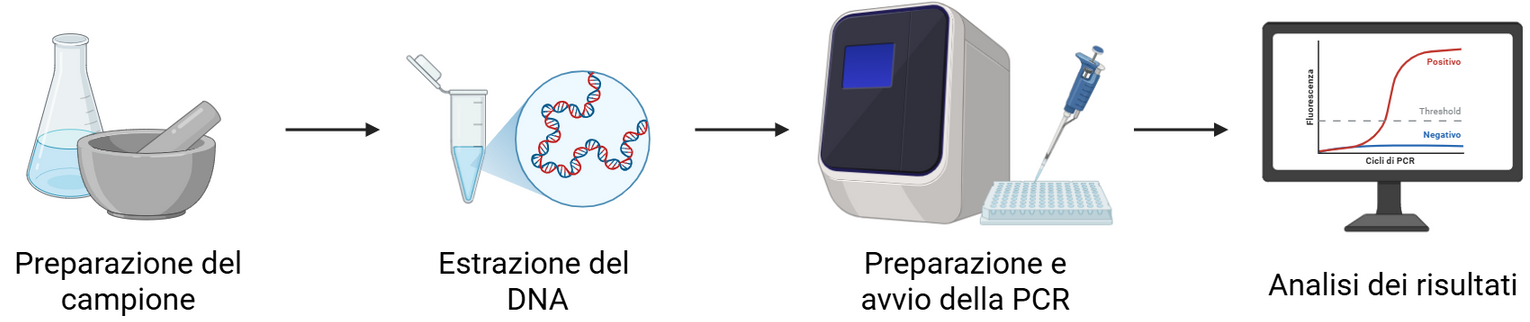
is a method used to amplify a specific DNA sequence in a reaction involving, among other components, a thermostable DNA polymerase, nucleotides, and primers complementary to the target sequence. The method involves several steps and must be performed with specific equipment. The test is quantitative as the reading is automated and the result indicates a contamination in quantitative terms.
The assay is based on real-time PCR reactions with 5’ nuclease to amplify a specific genomic sequence of the target.
Which tests are used for allergen declarations on labels?
ELISA and qPCR tests are used due to their sophisticated methodology and the ability to quantify contamination.
Which tests are used to detect food allergens during production?
Speed of intervention is needed during production phases, making rapid immunochromatographic screening tests useful. However, validating these rapid tests within one's own production context remains essential to ensure their effectiveness.
What equipment is required to detect food allergens?
It depends on the type of test. ELISA and qPCR tests require a fully equipped laboratory and a trained operator. Rapid tests are simpler to apply and usually only require small tools such as micropipettes and mixers.
Are food allergen detection tests validated?
Each manufacturer performs validation tests on their kits across various types of matrices. The end user then establishes a working procedure based on validation tests on their own specific matrices and operating conditions.